Nov 16, 2025
The ESG Expert's Systemagic Playbook: From Gap Analysis to Competitive Intelligence
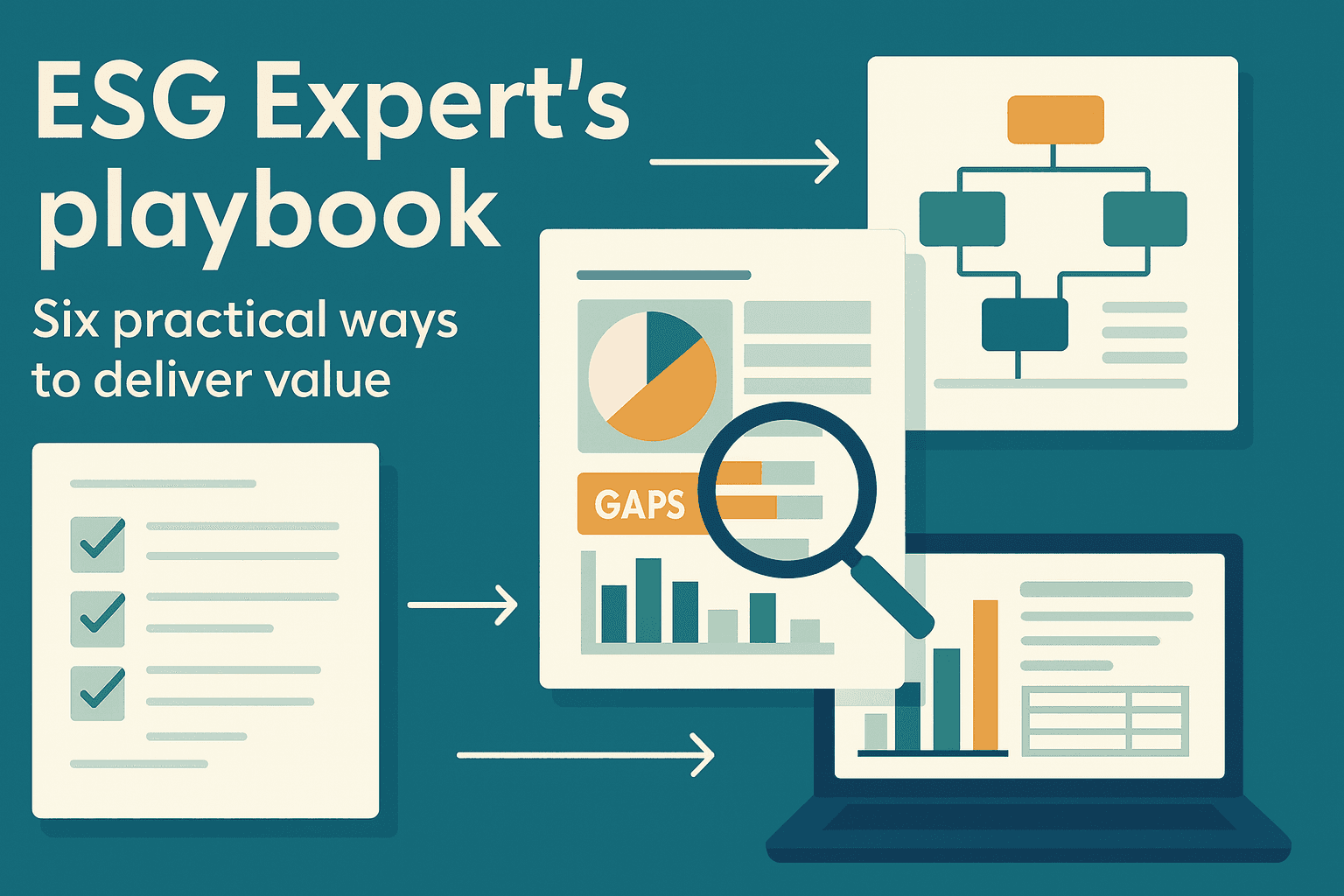
Six practical ways ESG experts are using Systemagic to deliver faster, more strategic sustainability work
Reading time: 5 minutes
As an ESG expert, you're constantly balancing speed and quality. You want thorough analysis, but you also need to deliver results quickly and affordably. The manual approach of reading through hundreds of pages, extracting datapoints, and compiling findings can take days or weeks.
Systemagic changes this equation. Here's how ESG experts are using the platform with different types of use cases, from initial assessments to ongoing advisory work.
Example 1: Client Gap Analysis
The scenario: Your need to understand your companies ESRS readiness. You have a sustainability report from last year, some operational documents, and scattered policies. You need to know what's missing before you can build an improvement plan.
Traditional approach: You spend 20+ hours manually reviewing documents, creating spreadsheets, cross-referencing ESRS requirements, and compiling a gap list. You spend in 2-3 weeks in the process.
The Systemagic approach:
Upload your companies documents to systemagic.ai (sustainability report, annual report, policy documents, certifications)
Select a suitable question template .e.g. GRI (Templates cover core questions you need to find answers to from the documents)
Start the scan - AI analyzes all documents and extracts answers in minutes
Examine specific gaps - Each unanswered or low-confidence question is flagged
Validate findings - Click through to see source quotes for answers that were found
Export to Excel - Generate a report with gaps highlighted
The value-add: You review the AI output, add industry context ("This gap is critical for your sector" vs. "This is likely not material for your business model"), and prioritize based on stakeholder pressure.
Time saved: 20+ hours reduced to 2-3 hours of strategic review.
Example 2: Create Competitor Benchmarking (To Understand Market Position)
The scenario: You want to know how a companies ESG performance compares to competitors. Is your company a leader, laggard, or middle of the pack? Which specific areas are you falling behind on?
Traditional approach: Manually read 5-6 competitor sustainability reports, extract key metrics, create comparison spreadsheets, analyze positioning. Takes 20+ hours.
The Systemagic approach:
Upload 5-6 competitor reports to Systemagic (publicly available sustainability reports)
Select question template, containing questions to ask all of the reports (e.g. 50 critical datapoints)
Start the scan - AI will systematically analyze all the documents in under 10 min.
Use the Compare View - See all companies side-by-side in a grid
Sort by performance - Identify which topics your company leads vs. lags on
Export the comparison - Generate presentation showing competitive positioning
The value-add: You interpret what the gaps mean strategically. "Our three main competitors all disclose Scope 3 Category 11 emissions, and they're using it in customer pitches. We can't compete on sustainability credentials without this data."
The impact: You see exactly where your company stands in the competitive landscape, not just abstract compliance gaps.
Time spent: 2 hours to understand how you fair with the competition.
Example 3: ESG Topic Deep-Dives (Understanding Disclosure Trends)
The scenario: You're asking yourself, "How are companies in our industry approaching biodiversity disclosures?" or "What are best practices for Scope 3 reporting in retail?" You need to quickly analyze how multiple companies address a specific ESG topic.
The systemagic approach:
Upload 10 relevant company reports (competitors or industry peers)
Filter to specific topic questions - Select only biodiversity-related questions (E4) or only Scope 3 questions
Review how each company answered - See actual disclosure language and approaches
Identify best practices - Which companies provide the most detailed, credible disclosures?
Spot common gaps - What are most companies NOT disclosing?
Extract language patterns - How do leading companies frame their commitments?
Synthesize findings - Provide client with "Industry approaches to [topic x]" summary
Consultant value-add: You help clients understand not just what to disclose, but how to disclose it effectively. "Here's how your top three competitors frame their biodiversity impact. Here's language that resonates with stakeholders."
Client impact: They're not inventing disclosure approaches from scratch. They're learning from industry leaders and adapting best practices.
Time spent: 1-2 hours to identify best practices and spot common gaps.
Example 4: Industry Benchmarking (Building Your Own Consulting IP)
The scenario: As a sustainability consultant you want to develop proprietary industry benchmarks that demonstrate your expertise and attract clients. For example, you want to become a thought leader in the Manufacturing sector, or Logistics industry by providing valuable insights through your marketing channels.
Traditional approach: This type of research project takes weeks and is often deprioritized because it's not billable client work.
The Systemagic approach:
Collect 15-20 sustainability reports from companies in a target industry
Upload all reports to a single comparison project
Run analysis across standard questions
Identify patterns - What percentage disclose Scope 3? What's the average governance score? Which topics are most commonly disclosed?
Spot trends - Are companies in this sector strong on climate but weak on biodiversity?
Create industry insights - For example, "Only 35% of logistics companies disclose Scope 3 Category 4 (Upstream transportation)"
Export aggregated data - Use findings for blog posts, LinkedIn content, pitch materials
Consultant value-add: You've now built credibility as an industry specialist. Prospects see your benchmarking reports and think, "They understand our sector."
Marketing impact: This becomes lead generation content. "Download our Manufacturing Sector ESG Benchmark Report" captures prospect information.
Time spent: 3-4 hours to create the needed benchmark data and spot trends.
Example 5: Supplier ESG Screening (Due Diligence at Scale)
The scenario: Your are evaluating 5-8 potential suppliers and needs to assess ESG risk as part of procurement decisions. Each supplier has provided sustainability documentation of varying quality.
Traditional approach: Manually review each supplier's documents, extract key risk indicators, create comparison framework. Time-intensive and often leads to rushed decisions.
The systemagic approach:
Upload supplier sustainability reports/policies (or whatever documentation they've provided)
Create custom screening question template - Focus on questions relevant to supply chain risk (labor practices, environmental compliance, governance structure)
Run analysis across all suppliers
Use Compare View - See all suppliers side-by-side on critical criteria
Red flags - Identify suppliers with missing documentation on high-risk topics
Generate supplier scorecards - Export comparison showing which suppliers meet criteria
Document findings - Every assessment is source-linked and auditable
The value-add: You get strategic understanding on supplier risk profiles: "Supplier A has lowest cost but significant gaps in labor policy documentation. Supplier C costs 4% more but substantially lower ESG risk."
The true impact: Make informed procurement decisions that account for ESG risk, not just price and quality.
Example 6: Annual Progress Tracking (Year-Over-Year Improvement)
The scenario: As a sustainability consultant you've been working with a client for 12-18 months. They've implemented improvements based on your initial gap analysis. Now they want to demonstrate progress to stakeholders, board, or for their next sustainability report.
The Systemagic approach:
Upload Year 1 report (baseline) and Year 2 report (current)
Run same question template on both documents
Use Compare View to see Year 1 vs. Year 2 side-by-side
Identify improvements - Which gaps were closed? Where did scores increase?
Spot regressions - Did any areas get worse or lose documentation?
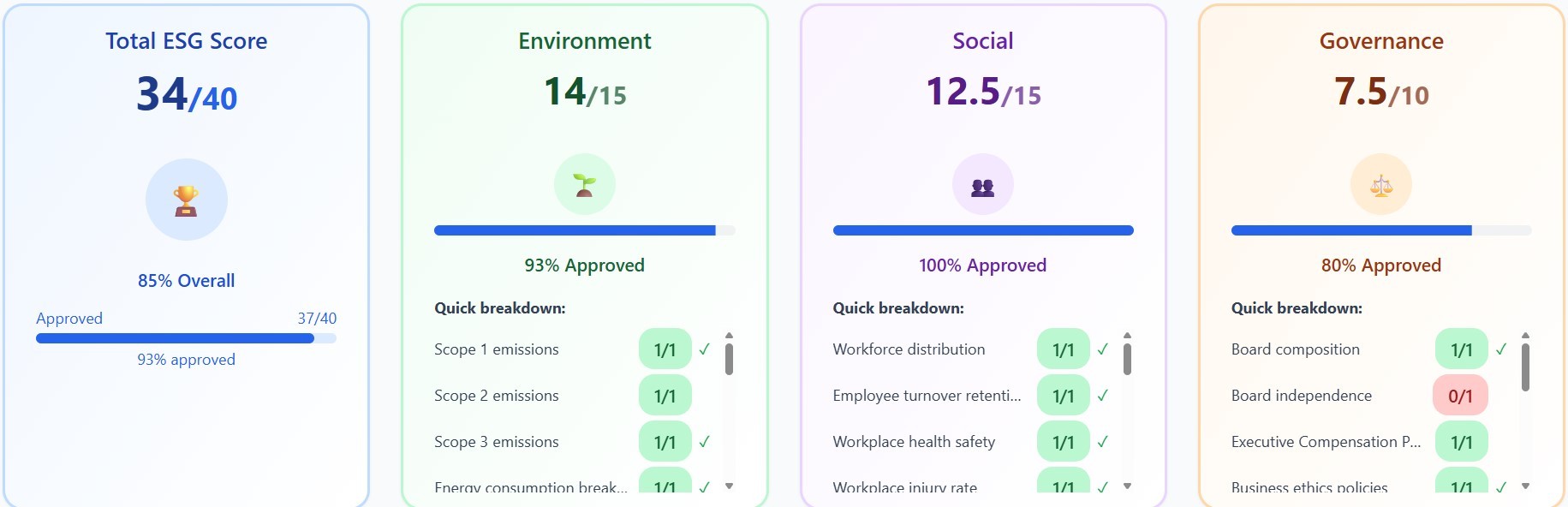
Quantify progress - "You went from 62% complete to 87% complete on Environment pillar"
Export progress report - Show board/investors concrete improvement metrics
Consultant value-add: You contextualize progress and set next priorities. "You've made strong progress on governance and social metrics. Climate disclosure is now your biggest competitive gap compared to peers."
Client impact: They can demonstrate ROI on their ESG investment. "We improved our ESG documentation completeness by 25% in 12 months."
[Screenshot: Year-over-year comparison showing improvement across pillars]
The Core Workflow of Systemagic
Across all these examples, the basic Systemagic workflow is consistent:
Step 1: Document Collection
Gather PDFs (sustainability reports, policies, certifications, annual reports)
Upload to Systemagic project
Step 2: Template Selection
Use pre-built templates (ESRS-lite, ESRS-full, GRI, SFDR) or create custom templates
Choose questions relevant to your analysis scope
Step 3: AI Analysis
Start scan (takes minutes, not hours)
AI extracts answers and links to source quotes
Every answer shows exact page and quote from source document
Step 4: Strategic Review
Review AI findings for accuracy
Add industry context and materiality assessment
Annotate with consultant insights
Step 5: Comparison & Analysis (when relevant)
Use Compare View for multi-company analysis
Sort and filter to identify trends
Step 6: Deliverable
Export to Excel with findings
Add your strategic recommendations
Present to stakeholders with actionable next steps
Why ESG Professionals Choose Systemagic
The ESG experts getting the most value from Systemagic aren't using it to replace their expertise. They're using it to eliminate the tedious parts of ESG analysis so they can focus on strategic interpretation.
As an expert you still provide the industry context, the competitive intelligence, the materiality judgment, and the strategic roadmap. But you're not spending days manually extracting datapoints from PDFs anymore.
The result: You can get more done and spend your time on the high-value advisory work that your company needs.
Whether you're doing initial gap analyses, competitive benchmarking, or ongoing progress tracking, Systemagic handles the data extraction so you can focus on strategic insights.
Ready to see how it works? Start your free trial and explore how it words with your own documents. No credit card required.
Keywords: ESG consulting tools, sustainability report analysis, competitive ESG benchmarking, ESRS gap analysis software, ESG consultant efficiency, sustainability data extraction, ESG comparison tool