Nov 13, 2025
How Mid-Sized Companies Are Getting Ahead Despite the CSRD Uncertainty
How forward-thinking sustainability managers are building ESG capabilities that work, regardless of what regulations finally say
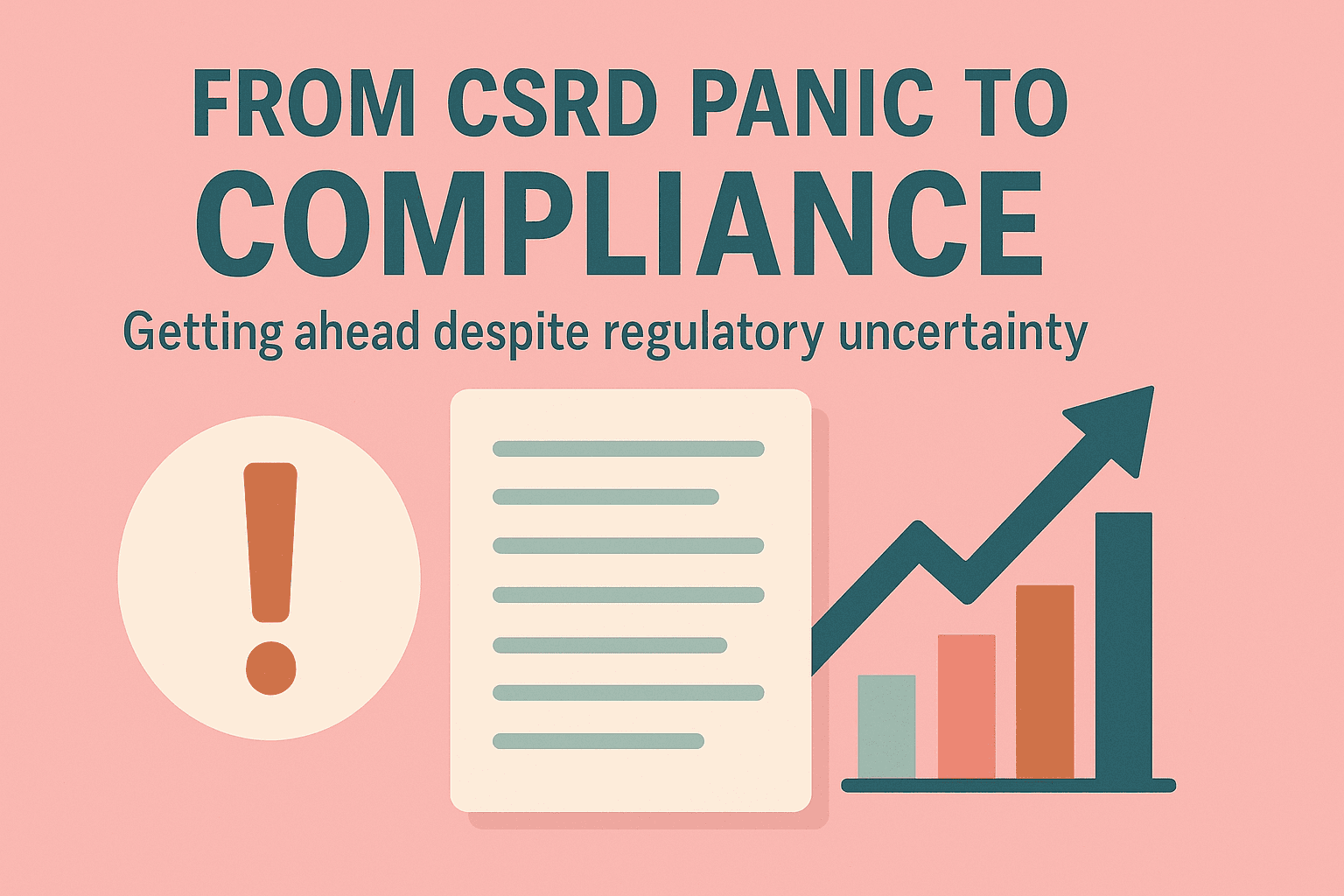
If you're a sustainability manager at a mid-sized EU company right now, you're facing a strange paradox: CSRD regulations are both getting simpler and more uncertain at the same time.
Here's what's happened in 2025 alone:
February: The EU Commission proposed slashing CSRD scope by 80%—only companies with 1,000+ employees would report
July: EFRAG released a draft of the simplified ESRS standards, cutting mandatory datapoints by 68%
October-November: Parliament and Council negotiations continue on final thresholds
Reality: Final CSRD scope won't be clear until late 2025 at earliest, with trilogue negotiations ongoing
The Question Keeping You Up at Night
Many sustainability experts are currenlty stuck between two futures:
Scenario A: Your company falls below new thresholds → CSRD doesn't apply (but customers and banks still ask for ESG data)
Scenario B: You stay in scope → Need simplified ESRS compliance
So what do you do? Wait for clarity? Start preparing now? Hire expensive consultants just in case?
Here's the counterintuitive truth: The companies thriving in this uncertainty aren't waiting for regulatory clarity. They're building systematic ESG capabilities now, because regardless of CSRD's final form, ESG disclosure isn't going away.
Let's explore why waiting is the riskiest strategy, and what forward-thinking sustainability managers are doing instead.
What We Actually Know About CSRD For Certain
Despite all the regulatory back-and-forth, three things are becoming clear:
Scope is narrowing: The Omnibus proposals raise thresholds to 1,000+ employees (plus €50M turnover or €25M balance sheet), reducing covered companies by roughly 80%
Standards are simplifying: EFRAG's revised ESRS cuts mandatory datapoints by 57% and total disclosures by 68%, with stronger focus on materiality-based reporting
Timeline is extending: The "stop-the-clock" directive postpones Wave 2-3 reporting by two years
What This Actually Means for Mid-Sized Companies
If you have fewer than 1,000 employees:
You'll likely be exempt from mandatory CSRD, but here's what won't change:
Larger companies in your value chain can still request ESG data from you (the "value chain cap" sets limits but doesn't eliminate requests entirely)
Banks, investors, and customers increasingly demand ESG disclosures regardless of legal requirements
You may face the VSME (Voluntary Standard for SMEs) instead, which is "voluntary" in name only when your biggest customer requires it
Your competitors who build ESG capabilities now will win tenders and financing that you won't
If you have 1,000+ employees but were below the old thresholds:
You thought you were Wave 2 (reporting 2026) → now you're Wave 1 with new thresholds (reporting 2028)
Simplified ESRS means less data-points, but the amount of data needed is still substantial
You have extra time, but also face new materiality assessment requirements that focus on what truly matters for your business
The Hidden Costs of Waiting
Let me paint you a picture of what might happen if you "sit and wait" for regulatory clarity.
It's a Tuesday morning, and you're sitting in a conference room with your CFO. The final CSRD regulations were published a few months ago, and it turns out—you're in scope. Your first report is due in about a year.
The CFO asks the question you've been dreading: "So, where do we stand on this?"
You pull up the documents you have. There's that sustainability report from a couple of years ago—nice looking, covered the basics, but it was designed for marketing, not regulatory compliance. The format doesn't match what ESRS requires, and half the metrics aren't even tracked the same way anymore.
Then there's the operational data. Energy consumption numbers exist somewhere—probably in facility managers' inboxes, mixed in with vendor quotes and maintenance schedules. HR has diversity data, but it's spread across their recruitment system, the payroll platform, and some Excel sheets that date back to the previous HR manager. As for carbon emissions beyond your direct operations? You've talked about calculating Scope 3 for two years, but never got around to building a methodology.
The CFO is still looking at you expectantly.
You've reached out to three consulting firms. The quotes come back higher than you expected—much higher. And that's not even the worst part. They're all telling you the same thing: they're booked solid for the next several months. Everyone who waited for regulatory clarity is now competing for the same pool of consultants, all rushing toward the same deadline.
The CFO shifts in their chair. "Couldn't we have started this earlier?"
Here's what makes this scenario particularly painful: You knew this was coming. You'd been monitoring the regulations. You were being prudent, waiting for clarity. But while you were waiting, the window to prepare systematically was quietly closing.
The Strategic Alternative for sustainability experts
Forward-thinking sustainability experts aren't betting on regulatory outcomes. They're building ESG competency as a business capability—not because they're certain CSRD will apply to them, but because they know the questions are coming regardless of who's asking them.
The Strategic Shift: From Compliance Guessing to Capability Building
Smart sustainability managers are asking "regardless of" questions. The wrong question to ask is "Will CSRD apply to us?", when the impacful question to ask is "What ESG data infrastructure do we need, regardless of mandatory reporting?"
Because here's the reality in 2025:
ESG Disclosure Pressure Comes From All Directions
1. Value Chain Requests
Even if you're below 1,000 employees, larger customers and partners in your value chain are requesting ESG data to complete their own CSRD reports. B2B customers send supplier sustainability questionnaires (often 50-100 questions). You either provide credible, source-linked answers or lose the business.
2. Financial Institutions
Banks are embedding ESG criteria into lending decisions (EU Taxonomy-aligned financing = better rates). Similarly, private equity and VC funds often require portfolio company ESG reporting. In addtion, insurance premiums are increasingly tied to ESG risk profiles. Therefore, many companies benefit from having ESG reports, even though it would be "voluntary" for them.
3. Talent & Reputation
Young professionals filter job searches by company sustainability credentials and B2B buyers compare suppliers' ESG maturity in tender evaluations. Your business will suffer by narrowing your potential talent pool and customers. Not only that, media nad NGO scrutiny of environmental claims can cause a company reputation and business harm.
The Core Capability Your Company Needs (CSRD or Not)
Regardless of final regulations, you need the ability to:
Extract answers to ESG questions from your existing documentation
Verify claims with source-linked evidence (no more "trust us" statements)
Compare your performance against industry benchmarks
Adapt quickly when stakeholders ask different questions
Building Your ESG Data Foundation: A 90-Minute Start
Here's how forward-thinking sustainability managers are creating systematic ESG capabilities, starting today.
Step 1: Gather What You Have (Even If Imperfect)
Start by compiling all existing ESG-related documents:
Last sustainability or CSR report (if any)
Annual financial report (often contains climate and risk data)
Energy audit reports, utility bills
HR diversity reports, training records
Supplier assessments, code of conduct documents
Any ISO certifications (14001, 45001, etc.)
Don't worry if these feel incomplete. You're establishing a baseline, not claiming perfection.
Step 2: Run a Systematic Gap Analysis
This is where traditional approaches break down—and where technology changes everything.
Traditional approach:
Manually review documents, trying to make sense of things, and remembers important datapoints
Still don't know which specific datapoints are missing
No documentation trail for what you do have
The Systemagic approach:
Upload your existing documents to the platform
Select the ESRS-question template of your preference (questions cover all sustainability topics)
AI extracts answers from your documents in minutes
See exactly what you have vs. what's missing:
Overall readiness: 76% complete
Environment pillar: 58% complete (12 critical gaps identified)
Social pillar: 72% complete (6 gaps)
Governance pillar: 85% complete (3 gaps)
Follow the data trail to see exactly which documents the answers are generated from.
The Real Value:
Time: 90 minutes vs. 16 hours
Cost: ~20€ in systemagic.ai in licence fees vs. 2000€ in "unnecessary" salaries
Clarity: Specific list of missing datapoints
Source verification: Every AI-extracted answer shows the exact quote and page number from your documents
Audit readiness: Built-in documentation trail from day one
Step 3: Understand Your Materiality Context
The simplified ESRS emphasizes "top-down" materiality, focusing on what matters for your specific business model and industry.
Example materiality guidance:
Manufacturing company → E1 (Climate) and E2 (Pollution) are highly material
Urban office-based services → E4 (Biodiversity) likely not material
Labor-intensive retail → S1 (Own Workforce) is critical
At this step you may consider highering a sustainability consultant, but do it the smart way. To get a better understanding on where you could possibly use a consultants expertise, you can read the blog behind this link.
Step 4: Create Your Priority Action List
Now you know exactly where you stand:
Easy wins: Data exists but not compiled (e.g., training hours in HR system)
Moderate effort: Data partially tracked (e.g., Scope 1-2 emissions from energy bills, but no formal calculation)
True gaps: Data not tracked at all (e.g., Scope 3 emissions, biodiversity impact assessments)
Prioritize based on:
Value chain pressure (customers asking for this data now)
Materiality (industry-critical topics)
Feasibility (can we get this data with existing resources?)
The Outcome After Week One
Within one week of starting, you have:
✅ Baseline understanding of current ESG data maturity
✅ Specific, actionable list of gaps
✅ Clear priorities based on stakeholder needs + materiality
✅ Foundation for either CSRD compliance OR sophisticated value chain responses
✅ Documentation trail showing exactly where every claim comes from
Cost so far: ~20€ (systemagic platform cost) + 10-15 hours internal time
Alternative cost if you outsourced this: €8,000-€12,000 consultant engagement
What Happens Next?
Once you have your gap analysis, you'll work with your internal teams (finance, HR, procurement) to fill the priority gaps. This is organizational work that requires internal coordination—not something a tool solves on its own.
Your gap analysis output from Systemagic gives department heads specific data requests instead of vague "send me sustainability info" emails. This alone cuts coordination time by 60-70%.
Many companies also bring in a consultant at this stage—but now for targeted help (e.g., "develop our Scope 3 methodology") rather than starting from scratch.
The Competitive Implications: Two Paths Forward
As we approach final CSRD clarity (likely late 2025 / early 2026), mid-sized European companies are diverging into two distinct groups.
Group A: The Capability Builders (Est. 15-20% of mid-sized companies)
Their approach:
Started systematic ESG data infrastructure in 2024-2025
Built capability before knowing final regulatory requirements
Can respond to value chain ESG requests in days, not months
Have audit-ready source documentation for all claims
Will easily adapt to simplified ESRS when it's finalized.
Their competitive advantages:
✅ Win tenders requiring ESG credentials
✅ Access to sustainable finance (green loans, sustainability-linked bonds)
✅ Attract ESG-conscious talent and customers
✅ Reduced audit and verification costs (documentation already exists)
✅ Minimal panic when regulatory clarity arrives
Group B: The Wait-and-See Majority (Est. 80-85%)
Their approach:
"We'll worry about it when the regulations are final"
Responding to value chain ESG requests ad-hoc (if at all)
No systematic documentation infrastructure
Treating ESG as compliance burden, not business capability
Their risks:
❌ Scramble mode when regulations finalize
❌ Consultant capacity crunch (everyone needs help at once)
❌ Premium rates for rushed work
❌ Lost business opportunities (can't respond quickly to ESG tender requirements)
❌ Reputation risk (vague or unverifiable ESG claims)
The Compounding Effect
This isn't about 2027 compliance. It's about 2025-2030 competitiveness.
Companies with systematic ESG capabilities:
2025-2026: Winning value chain business with credible ESG data
2027: Smooth CSRD compliance (or sophisticated voluntary reporting)
2028+: ESG data integrated into business strategy (product design, supplier selection, risk management)
Companies still scrambling:
2025-2026: Losing tenders, paying ESG "ignorance tax"
2027: Rushed, minimum-viable compliance
2028+: Still treating ESG as compliance burden, not strategic asset
The Question:
Regardless of CSRD's final form, which group do you want to be in?
Your 4-Week ESG Foundation Plan
Ready to build systematic ESG capabilities? Here's your actionable roadmap:
Week 1: Assess Your Current State
Compile all existing ESG-related documents (reports, audits, certifications, policies)
Identify data owners internally (who tracks energy? HR metrics? Governance?)
Sign up for Systemagic free trial
Upload documents and run ESRS-lite template scan
Review completion dashboard and gap analysis
Week 2: Understand Your Stakeholder Pressure
List all ESG data requests received in past 12 months (customers, banks, investors)
Identify common themes in those requests
Map Systemagic's gap analysis against actual stakeholder needs
Prioritize gaps based on: stakeholder pressure + materiality + feasibility
Week 3: Create Your Action Plan
For each priority gap, assign an internal owner
Estimate effort required (e.g., "HR can export training hours in 2 hours")
Identify areas needing external help (e.g., Scope 3 methodology)
Build timeline: Quick wins (30 days), Medium-term (90 days), Long-term (6+ months)
Week 4: Build Business Case for Leadership
Calculate cost of systematic approach: €X internal time + €Y targeted consulting
Compare to cost of last-minute scramble: €Z rushed consulting + lost opportunities
Present to CFO/Board: "Invest €X now to save €Y later + unlock competitive advantages"
Get budget approval for priority gaps
The Timeline Reality
If you start this plan in November 2025:
By January 2026: Clear baseline, priority gaps identified
By mid-2026: Major gaps filled, audit-ready documentation system
When regulations finalize (late 2026?): Ready to comply with minimal stress
Or if exempt from CSRD: Sophisticated ESG capability for value chain and financing needs
If you start in late 2026 after regulations finalize:
Scramble mode, premium consultant rates, organizational stress
Missed competitive opportunities throughout 2025-2026
Stop Waiting. Start Building.
The EU sustainability landscape is in flux—but your need for credible, verifiable ESG data isn't.
Systemagic helps you build systematic ESG capabilities that serve you regardless of CSRD's final form.
What You Get With a Free Trial:
✅ Upload your existing sustainability documents
✅ Run ESRS-lite gap analysis (150 questions, all major topics)
✅ See exactly which datapoints you have vs. need
✅ Get source-linked evidence for every answer
✅ Export priority action plan for your team
✅ Build audit-ready documentation from day one
The Bottom Line
CSRD regulations will eventually settle. But by then, the competitive landscape will have already shifted.
Companies building ESG capabilities today aren't preparing for compliance. They're positioning for opportunity.
The question isn't whether you'll eventually need systematic ESG data. The question is whether you'll have it when it matters most.
About Systemagic: We help sustainability managers extract, verify, and organize ESG data from reports and websites—turning scattered documents into systematic insights in minutes, not weeks. Built for EU sustainability professionals who need CSRD-ready capabilities without the consulting fees.
Ready to see where you stand? Start your free gap analysis →