Dec 4, 2025
Why do we still need sustainability consultants in the age of AI?
Is AI replacing the ESG consultant? No. But it is separating the data processors from the strategic advisors. Learn the Three-Layer Consulting Model that allows you to automate baseline analysis, increase client volume, and reposition yourself for high-margin strategic advisory work.
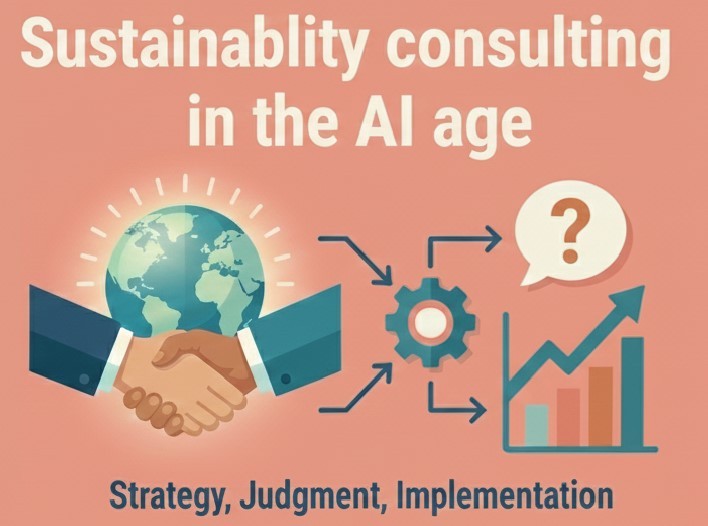
If you’re an ESG consultant, you’ve heard some version of this question in the past year. Maybe it came from a prospect experimenting with ChatGPT. Maybe from an existing client who just discovered an automated gap analysis tool. Or maybe, it came from the voice in your head at 2:00 AM.
The anxiety is valid. Clients are getting smarter about AI capabilities. They are rightfully wondering if they are paying consultant rates for work that software can now do faster and cheaper.
But here is the reality: AI is changing ESG consulting, but not in the way most fear.
The consultants thriving right now aren't fighting AI. They are repositioning themselves around it by moving from data extraction to strategic interpretation. They are discovering that AI doesn’t replace consultant value, it amplifies it.
Here is how to survive the shift and build a more profitable practice.
What’s Actually Changing (And What Isn’t)
Let’s be brutally honest about what AI can and cannot do in our industry.
What AI Can Do: AI tools can ingest a 100-page sustainability report in minutes. They can systematically identify missing ESRS datapoints, flag inconsistencies across documents, and generate a first-draft gap analysis that used to take a human 16 hours. This changes the economics of basic analysis forever.
What AI Cannot Do: AI cannot understand why biodiversity disclosure is critical for a logistics company but irrelevant for an urban software firm. It cannot navigate the office politics when a CFO and Sustainability Manager disagree on disclosure strategy. It cannot coach a nervous client through a procurement negotiation.
The Shift: Consultants are moving from being "Data Archaeologists" to "Strategic Architects." If your primary value was reading documents and extracting rows of data, you are facing commoditization. But if your value is industry judgment and implementation support? You have never been more expensive—or more necessary.
The New Value Proposition: Strategy Over Scrutiny
The traditional consulting pitch went something like this:
"We will thoroughly analyze your documentation, identify gaps against ESRS, and deliver an assessment."
The problem? Clients can now get a "good enough" version of this from software like Systemagic.ai in minutes. If you sell document analysis, you are in a race to the bottom on fees.
The new positioning looks like this:
"We help you turn compliance into competitive advantage. We use technology to handle the data baseline, so we can focus on showing you how you compare to competitors, which gaps actually threaten your revenue, and how to build a roadmap your team can handle."
You aren't selling the what (the gaps). You are selling the so what (the strategy).
The Three-Step Model for Sustainability Consultants
Leading firms are restructuring their service offering into three distinct layers.
Step 1: Preliminary Analysis to Get The Foot in the Door
This is where AI does the heavy lifting. You use tools like Systemagic for data extraction and baseline review.
The Shift: What took 16 hours of manual reading now takes 2 hours of AI-augmented review and verification.
The Economics: Yes, the per-project fee is lower here. But because you are faster, this becomes your high-volume client acquisition tool. You can now audit five times as many prospects in the same timeframe.
Step 2: Strategic Interpretation for Premium Value
This is where the human consultant is irreplaceable.
Benchmarking: You don't just show scores; you explain market positioning. "Your governance score is 65%, but the industry average is 78%. This makes you risky to investors."
Materiality: You make the judgment calls. "Given your upcoming refinancing, we need to prioritize these three social metrics because your bank weighs them heavily."
The Economics: This is high-margin work. Clients pay for the "Why," not the "What."
Step 3: Implementation Support for Recurring Revenue
This is where you move from a transaction to a partner.
The Work: Building roadmaps, facilitating internal stakeholder alignment, and tracking quarterly progress.
The Economics: Clients who start with a €800 baseline assessment often convert into €15,000–€20,000 annual engagements because they realize they need help fixing the problems you found.
Building Trust in an AI-Augmented World
Your clients will ask: "If you’re using AI, why should I pay consultant rates?"
Transparency is your best defense. Use the "Architect" analogy:
"We use AI the way architects use CAD software. It makes us faster and more precise, but the design expertise is still human. You aren't paying me to read 500 pages of PDFs. You're paying me to tell you what to do with the information found in them."
Three ways to prove value:
Source-Linked Evidence: Every AI finding must trace back to a specific page or quote. "Audit-ready" is the new standard.
Context is King: AI points out a gap in Scope 3 data. You explain that for their specific sector, only Categories 1 and 11 matter right now. That insight saves them weeks of wasted work.
The "So What": AI says the score is low. You explain that the low score will likely cost them their next contract renewal with their biggest customer.
The Competitive Advantage: Scale + Quality
The limiting factor for boutique consultants has always been capacity. There are only so many hours in the day to read reports. AI removes this ceiling.
By adopting this model, you unlock a new sales funnel:
Acquisition: Offer low-friction "ESG Baseline Assessments" at €800–€1,200. It’s an easy "yes" for prospects.
Conversion: 60% of these clients realize they are further behind than they thought.
Retention: They hire you for the €15k strategic roadmap to fix the gaps.
Big 4 firms are too slow to integrate these tools. DIY software leaves clients overwhelmed with data but no direction. The AI-Augmented Boutique Consultant sits in the sweet spot: fast, affordable, but deeply strategic.
Time to Pivot
The transition doesn't happen overnight, but you can start today.
Step 1: Start by using one AI data-tool on your next project and compare the results with your manual process.
Step 2: Update your service descriptions. Stop selling "Report Analysis" and start selling "Strategic Roadmaps."
Step 3: Adjust your pricing. Lower the entry barrier for the diagnostic, and raise the price for the strategy.
The question isn't whether to embrace AI-enhanced consulting, the question is whether you’ll adapt before your competitors do.
Ready to automate the data extraction? Systemagic helps ESG professionals extract and analyze sustainability data from reports and websites in minutes. Use us for your Step 1 baseline assessments so you can focus your expertise on Step 2 and 3. See how it works →
Keywords: ESG consulting, AI ESG analysis, CSRD consulting services, sustainability consulting business model, ESG strategic advisory, boutique ESG consultants.